• Welcome to The Building Code Forum

    Your premier resource for building code knowledge.

    This forum remains free to the public thanks to the generous support of our Sawhorse Members and Corporate Sponsors. Their contributions help keep this community thriving and accessible.

    Want enhanced access to expert discussions and exclusive features? Learn more about the benefits here.

    Ready to upgrade? Log in and upgrade now.

Crawl space depth?

Blobis

REGISTERED
Joined
Dec 3, 2025
Messages
5
Location
California
Hello everyone.
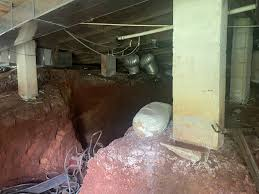
I've lived in this half manufactured half stick house for about a year now in Riverside County California, wonderful place to live.
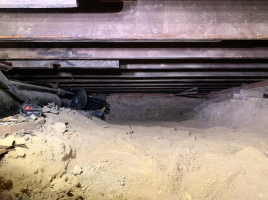
Every time I have to fix something under the house, I'm in the crawl space.
I don't know what the previous owners did but I know for a fact that the crawl space depth is way too shallow.
Does anyone know what the maximum depth from under the house to dirt floor should be?
Thanks, Bob
 
  • Like
Reactions: ICE
What the code requires is minimum 18" clear between bottom of the wood joists to earth, and minimum 12" clear between bottom of a girder to earth. I would NOT presume that what was built/done was to any code. The only "maximum" dimension would be in determining whether you have the possibility for habitable space in that area.
 
The only "maximum" dimension would be in determining whether you have the possibility for habitable space in that area.
How would I go about finding that out?
Thanks.
 
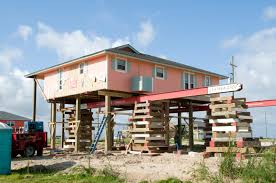
A "maximum" would be limited by structural design and money. You could build a crawl space with 45 feet "depth from under the house to dirt floor" but the engineering would be impressive, and expensive.
1764778886322.png
 
Seems like the real concern isn't the maximum but the minimum. I can say as a person who has shimmied on their backs under beams it isn't pleasant and I have often wished there was a requirement for a minimum number that wasn't 12" or 18", but there isn't one as far as I know. Plus those minimums go away if the beams and floor framing is decay resistant. There are also minimum access door sizes and appliance pathways but only where appliances are in the crawlspace and those dimensions only apply to the pathway.
 
A "maximum" would be limited by structural design and money. You could build a crawl space with 45 feet "depth from under the house to dirt floor" but the engineering would be impressive, and expensive.
View attachment 17267
Wow, that picture is awesome. But where do I go about finding out what the max is without permits in my county? I've been looking through Ca Riverside County Building Code web site and can't find anything.
 
Seems like the real concern isn't the maximum but the minimum. I can say as a person who has shimmied on their backs under beams it isn't pleasant and I have often wished there was a requirement for a minimum number that wasn't 12" or 18", but there isn't one as far as I know. Plus those minimums go away if the beams and floor framing is decay resistant. There are also minimum access door sizes and appliance pathways but only where appliances are in the crawlspace and those dimensions only apply to the pathway.
My beams are decay resistant. They are I beams.
 
Wow, that picture is awesome. But where do I go about finding out what the max is without permits in my county? I've been looking through Ca Riverside County Building Code web site and can't find anything.
Call and ask.
 
Wow, that picture is awesome. But where do I go about finding out what the max is without permits in my county? I've been looking through Ca Riverside County Building Code web site and can't find anything.
I don't believe there is a "maximum" anywhere in state code. So, it can be as high as you want. That by itself doesn't determine if you need a permit or not.

With the limited info I have, I'm guessing that one of the following likely happened:
1.This house is old and either didn't require a permit or the local building codes at the time didn't have a minimum crawlspace height (if your house was built prior to 1961, there was no state code),
2. Over time dirt accumulated below the house, reducing the depth of the crawlspace (happened to my grandparent's home, but this is usually rare, I think...),
3. Someone did illegal unpermitted work (happens all the time in residential),
4. The inspectors either didn't catch the error or ignored the violation (I have plenty of experience with inspectors actively ignoring violations, but that's somewhat unique to one jurisdiction near me - not Riverside).
 
Wow, that picture is awesome. But where do I go about finding out what the max is without permits in my county? I've been looking through Ca Riverside County Building Code web site and can't find anything.
Max building height is a zoning regulation (planning and land use) that is set by the local jurisdiction.

Are you suggesting you want to raise the whole house? That's going to require a permit.
 
2. Over time dirt accumulated below the house, reducing the depth of the crawlspace (happened to my grandparent's home, but this is usually rare, I think...),
I've seen this a few times, but it was actually the house sinking over time rather than the dirt "accumulating". Undersized footing and foundation depth on bay mud. Every year when the soil saturates the house may sink up to 0.05" without anyone ever noticing. Over 50 years that's a couple of inches, that's significant.
 
I've seen this a few times, but it was actually the house sinking over time rather than the dirt "accumulating". Undersized footing and foundation depth on bay mud. Every year when the soil saturates the house may sink up to 0.05" without anyone ever noticing. Over 50 years that's a couple of inches, that's significant.
That makes a lot more sense then whatever my brain thought happened lol.
 
Max building height is a zoning regulation (planning and land use) that is set by the local jurisdiction.

Are you suggesting you want to raise the whole house? That's going to require a permit.
No, I want to dig it out to a comfortable depth, so when I'm working under there, I can at least sit up straight. Just need to know what is to deep.
 
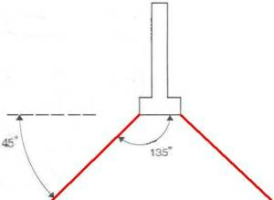
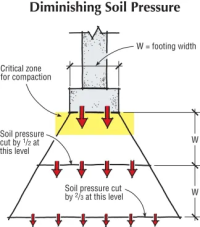
Be careful not to undermine your footings. You would want to maintain at least a 45-degree angle from any foundation elements. So, if you want to dig down 12 inches, you will need to be at least 12 inches away from any foundation elements. If you have four feet between two posts, you could dig a 12-inch-deep trench, 24-inches wide centered between the posts.
1764783694347.png

1764783723271.png
 
I did this once. Guessing you have center piers and footings. Stop when you hit the footings or you could compromise them.
 
I usually design crawl spaces to be 32" high. This allows 2 feet or so to get under beams, ducts, & pipes.

I remember seeing a house that was built back in the 70s with a 4 foot crawl space. Unfortunately the plumber decided to run the pipes in the middle, so getting under them was almost as much of a hassle as getting over them. Since then I've put a note to bury pipes that go all the way through the crawl space and keep other piping tight to floor joists.
 
Back
Top