• Welcome to The Building Code Forum

    Your premier resource for building code knowledge.

    This forum remains free to the public thanks to the generous support of our Sawhorse Members and Corporate Sponsors. Their contributions help keep this community thriving and accessible.

    Want enhanced access to expert discussions and exclusive features? Learn more about the benefits here.

    Ready to upgrade? Log in and upgrade now.

Article on centralizing code interpretations at the state level, for affordability

I can see both good and bad outcomes of something like that. It seems like the desire for universal interpretation is for housing costs. Beating a dead horse, but codes aren't the problem. Cost of construction has gotten higher in state that haven't changed their codes in over a decade, so codes aren't the smoking gun some people make them out to be. They play a roll, sure, but most of the time the primary cause of construction costs is something else.

Take the cost of living in the state. It's high. Workers demand (or need) higher pay. Add to that a shortage of workers and now contractors can change a premium. So construction labor costs are higher.

Inflation. Code doesn't stop the price of goods and materials from going up.

Tariffs. More of a recent problem, but that shot up the price of some of the things my firm used for well over a decade. Code interpretations won't stop that.

The cost of a small lot in CA can be as much as a 3-bed 2-bath house in other states. Still gotta buy the land to build on.

To me, anecdotally, the biggest issue is people's perception of housing. It's no longer a place to live. It's an investment, one that "will always appreciate". Whatever you build, whatever money you spend on improvements, will "always" increase the value. New homes are rarely affordable, at least in my area. The only thing that's affordable are cramped apartments that are still rented out for a few grand each. Prices can't drop, otherwise developers wouldn't build new homes. Can't turn a profit, then no reason to build. That's just business.

It won't solve the housing crisis. It could be good or bad depending on the location. But, personally, I think universal interpretations could be a net positive thing. Code interpretations are the number one cause of my firm's projects getting delayed. This would dramatically simplify the process for getting through plan review. Even if the interpretations increase costs, having certainty is something I value.
 
Last edited:
My state first adopted a mandatory state building code in 1971. With that adoption, the legislature established that only the State Building Inspector is authorized and empowered to issue interpretations of the code and to grant modifications to the code. This is established in statute, and has remained unchanged since the 1971 adoption of our first mandatory state building code.

As an architect, I believe this is the only logical way to handle it. This state has 169 incorporated municipalities, plus a few burroughs that somehow get to have their own building departments. From the perspective of an architect, a PE, or a property owner, if 175 (+/-) officials around the state can all make their own interpretations and issue their own modifications, then we don't have a uniform state building code, we have 175 individual codes. That's chaos.

Looking through UpCodes, it looks like California has six building codes, Arizona has two, Illinois has four, Texas has six, and a bunch of other states have at least two. That's insanity.
 
There is a credible premise behind the measure as described in the article however, it will not stop there. Governing 540 California jurisdictions will be worse than herding cats. As an example, I point to LA County. Dozens of contract cities and district offices are akin to fiefdoms. What you can do in one, you can't do in another. What you can't do in one you can do in another.

As was noted, a bureaucratic agency would emerge. Much like a fish, that agency will grow as large as the environment allows. The budget, sphere of influence and employee roster would balloon.

Sounds wrong but the fact is that a bureaucratic agency (State Legislators) is the entity that could give birth to it so look out you Building Officials, your mother-in-law is fixing to move into the spare bedroom.
 
My state first adopted a mandatory state building code in 1971. With that adoption, the legislature established that only the State Building Inspector is authorized and empowered to issue interpretations of the code and to grant modifications to the code. This is established in statute, and has remained unchanged since the 1971 adoption of our first mandatory state building code.

As an architect, I believe this is the only logical way to handle it. This state has 169 incorporated municipalities, plus a few burroughs that somehow get to have their own building departments. From the perspective of an architect, a PE, or a property owner, if 175 (+/-) officials around the state can all make their own interpretations and issue their own modifications, then we don't have a uniform state building code, we have 175 individual codes. That's chaos.

Looking through UpCodes, it looks like California has six building codes, Arizona has two, Illinois has four, Texas has six, and a bunch of other states have at least two. That's insanity.
Practical and reasonable in a relatively small state.
1764792141867.png
 
Looking through UpCodes, it looks like California has six building codes, Arizona has two, Illinois has four, Texas has six, and a bunch of other states have at least two. That's insanity.
All of the other California codes are just modified versions of the state code. If that's the qualifier for a unique building code, then technically most cities and counties in the state have a unique building code - every city I've worked in has some amendments to code. I think (someone correct me if I'm wrong) that UpCode lists those specific codes because they cover so many people or because those amendments have a large impact on life-safety. The amendments a smaller city like, idk, Santa Rosa makes to the Building Standard Code don't affect that many people when compared to SF or LA.

Edit: Even if they were unique codes, those specific areas tend to have geography and needs that the standard CBC just doesn't adequately address. So, the state either needs to change the codes so everyone fallows the more strict amendments SF and LA make, or strip a jurisdiction of it's ability to amend code. Pros and cons to each.
 
I can see both good and bad outcomes of something like that. It seems like the desire for universal interpretation is for housing costs. Beating a dead horse, but codes aren't the problem. Cost of construction has gotten higher in state that haven't changed their codes in over a decade, so codes aren't the smoking gun some people make them out to be. They play a roll, sure, but most of the time the primary cause of construction costs is something else.
The author's point was that uncertainty causes delays, and in the context of other time-sensitive factors such as inflation and tariffs, delays = $$.

I've mentioned elsewhere my previous battles with a local fire department that interpreted state fire code to require ladder inclination space underneath EEROs. This was forcing larger side yards, thus a smaller building. We eventually got clarification from the State Fire Marshall that there was nothing in the California Fire Code that triggered a ground ladder inclination space, and the local fire department was incorrect. That interpretation took many months to process.
 
I've mentioned elsewhere my previous battles with a local fire department that interpreted state fire code to require ladder inclination space underneath EEROs. This was forcing larger side yards, thus a smaller building. We eventually got clarification from the State Fire Marshall that there was nothing in the California Fire Code that triggered a ground ladder inclination space, and the local fire department was incorrect. That interpretation took many months to process.
I know you won the argument but did you not agree with local fire department?
 
I know you won the argument but did you not agree with local fire department?
The LFD was going to require ground ladder space even for windows on the first floor, where a ladder is irrelevant. Also, the State Fire Marshal determined ladder space was unneeded - - I assume they considered what it takes to rescue people out of an EERO.
If the LFD believes there is a prescriptive requirement for ladder use at EEROs, they need to amend the fire code to add this local requirement, and provide a clear method / calculation for designers to apply the requirement during the initial design, not wait to have it pop up as a stealth issue during plan check. That's a little late in the game to inform the design team that they need 10' side yards instead of 5' yards.
 
I assume they considered what it takes to rescue people out of an EERO.
Well you know what they say about that.

not wait to have it pop up as a stealth issue during plan check
Not a good way to conduct the business of regulating construction. Given the uniqueness of such a constraint, it should be a banner over the door.

they need 10' side yards instead of 5' yards.
That radical? Are you sure that you didn't stretch the numbers to match the complaint? Five feet has been enough for all but fattest firefighters.

State Fire Marshal determined ladder space was unneeded
Well I can't fly, I mean legally fly the plane. Yup, I'm on a no fly the plane list.
I could better appreciate the auspices of such a revered agency as the California State Fire Marshall if a determination included a recognition of a need for a ladder space. Come on .... No space needed? They could say that five feet is good but in a pinch three feet might be all you get ... but you have to have something.
 
All of the other California codes are just modified versions of the state code. If that's the qualifier for a unique building code, then technically most cities and counties in the state have a unique building code - every city I've worked in has some amendments to code. I think (someone correct me if I'm wrong) that UpCode lists those specific codes because they cover so many people or because those amendments have a large impact on life-safety. The amendments a smaller city like, idk, Santa Rosa makes to the Building Standard Code don't affect that many people when compared to SF or LA.

Edit: Even if they were unique codes, those specific areas tend to have geography and needs that the standard CBC just doesn't adequately address. So, the state either needs to change the codes so everyone fallows the more strict amendments SF and LA make, or strip a jurisdiction of it's ability to amend code. Pros and cons to each.

If a municipality has its own amendments to "the" code -- then it has a code that is unique to it.

I think it not just poor public policy but absolutely horrible public policy to allow such chaos.

Edit: Even if they were unique codes, those specific areas tend to have geography and needs that the standard CBC just doesn't adequately address. So, the state either needs to change the codes so everyone fallows the more strict amendments SF and LA make, or strip a jurisdiction of it's ability to amend code. Pros and cons to each.

That argument is, IMHO, a non-starter. There is NO geographic feature or element anywhere in California that doesn't also occur somewhere else in the United States and that isn't addressed by the ICC I-Codes.
 
If a municipality has its own amendments to "the" code -- then it has a code that is unique to it.

I think it not just poor public policy but absolutely horrible public policy to allow such chaos.


That argument is, IMHO, a non-starter. There is NO geographic feature or element anywhere in California that doesn't also occur somewhere else in the United States and that isn't addressed by the ICC I-Codes.
In that case, this will make you blow a gasket [Link] (scroll down to Section 4-1.4)

Look at all them amendments for a city with a population of 50k.
 
Last edited:
If a municipality has its own amendments to "the" code -- then it has a code that is unique to it.

I think it not just poor public policy but absolutely horrible public policy to allow such chaos.


That argument is, IMHO, a non-starter. There is NO geographic feature or element anywhere in California that doesn't also occur somewhere else in the United States and that isn't addressed by the ICC I-Codes.
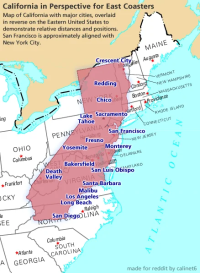
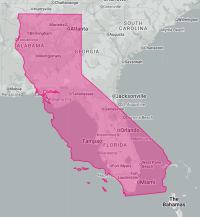
By that logic then why not suggest Virginia, Maryland, Pennsylvania, Delaware, New Jersey, New York, Connecticut, Rhode Island, and Massachusetts all unify their codes?
 
Well you know what they say about that.
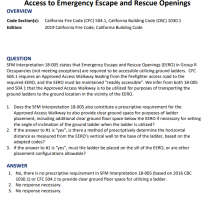
Here was my original question to the SFM, years ago:

"Does the SFM Interpretation 18-005 also constitute a prescriptive requirement for the Approved Access Walkway to also provide clear ground space for purposes of ladder placement, including additional clear ground floor space below the EERO if necessary for setting the angle of inclination of the ground ladder when the ladder is utilized?"

SFM's response: "No, there is no prescriptive requirement in SFM Interpretation 18-005 (based on 2016 CBC1030.1) or CFC 504.1 to provide clear ground floor space for utilizing a ladder."
 
Ask them again and include an inquiry as to should there be a requirement to accommodate a ladder.
I am willing to bet that traffic laws do not specifically prohibit driving the posted speed limit if you are in reverse gear. Just because something is not in a law does not make it okay.
 
Ask them again and include an inquiry as to should there be a requirement to accommodate a ladder.
I am willing to bet that traffic laws do not specifically prohibit driving the posted speed limit if you are in reverse gear. Just because something is not in a law does not make it okay.
Full text of the published Q and A with the SFM. In addition to this, the SFM had us submit additional background info about the specifics of the situation, which they do not publish to protect the privacy and opinions of both the Owner and the building / fire department. Helps people be less defensive when the response if published. My additional background info included NFPA 1932, which provides a prescriptive angle of inclination for ground ladders.

What I'm saying is, I have confidence they are fully aware that they require a 5' wide access path for the ground ladder from the Fire Apparatus to the EERO, but have no prescriptive requirement to create a working space to set the ladder onto the ground.

1764808736714.png
 
Last edited:
CA has had statewide codes for a long time. This article is proposing to institute a process to obtain written interpretations that are binding statewide on local AHJs.
 
Connecticut already did so, as I have stated, in 1971. IMHO, other states that have not done so should.
I get that. My point is that CA is larger (geographically) than all of those states combined. We do have a statewide minimum code, but each local jurisdiction is allowed to make reasonable modifications that a more restrictive, in most cases "due to local climatic, geological or topographical conditions." A good example is that many areas have added requirements for earthquake gas shutoff valves, due to our high seismic activity.
 
By that logic then why not suggest Virginia, Maryland, Pennsylvania, Delaware, New Jersey, New York, Connecticut, Rhode Island, and Massachusetts all unify their codes?
Virginia has had a uniform statewide building code since 1973. Each locality has an appeal board. There is a state Technical Review Board to hear appeals from local decisions and to issue interpretations when requested by the local building official.
 
Back
Top