• Welcome to The Building Code Forum

    Your premier resource for building code knowledge.

    This forum remains free to the public thanks to the generous support of our Sawhorse Members and Corporate Sponsors. Their contributions help keep this community thriving and accessible.

    Want enhanced access to expert discussions and exclusive features? Learn more about the benefits here.

    Ready to upgrade? Log in and upgrade now.

Do Code Section #s matter?

The question has come up many times scattered in threads that were drifted into a ditch. It just happened again so I brought my reply here.

Since 2006, OREGON requires all jurisdictions to cite the code sections for each violation. "Cite-it Write-it" And yes, we provide the code section(s). To the credit of the State, every inspector, plans examiner and Building Official has to be certified by the State of Oregon. (It can be such a pain looking up the codes sections!)
There are practical benefits to including a code section.

1. For example, office managers are seldom versed in code so when a constituent questions a violation, there is a roadmap for the manager. Of course that leaves that manager in the weeds with no understanding of the code that he had at his fingertips, but that's another issue.
2. A plus to providing code sections is the likelihood that the imbecile inspectors would be curtailed with their bogus corrections. But then, stupid goes all the way to the bone so perhaps that wouldn't work as well as I imagine.
3. The Yankee has mentioned respect for court proceedings. I have written north of 200K corrections and been in court twice. On both occasions it was two people suing each other. The one time where I came close to a court case, I fabricated the entire code without a section# in sight. I've probably already told that story, it was a doozy. (p.s. I did tell that story on 2/11/2025)

Having exhausted the obvious advantages. There are disadvantages.

1. The time taken looking up each correction can be significant. I suppose that over the long haul, there would be muscle memory. (the brain is a muscle) Cheat sheets are available. I have a stack of the Code Check aids. However, the time is wasted.
2. The one in 400 hundred contractors that demand a code section will have deflated sails. So I'm going on the offensive to thwart that single malcontent that comes around on the third Thursday of every month.
3. Here in SoCal the level of expertise with building inspectors is low. Like in in a basement toilet low. They do not write many corrections because they don't recognize violations. If they were required to include sections...well the inspection was for naught.

I can say with certainty that the condition holds true with contractors as well as inspectors. So we have the blind leading the blind and between the two of them they can't understand a code section. Be honest and see the truth found here in this forum. A question about the dimensions of a stair landing produced fifty replies. An exit sign might be required ...or maybe not... could be a good idea ...or wait a minute, does it create a hazard? Ah! But a code section clears the smoke???

Some would say that sounds harsh. Well they are the exception rather than the rule. It all depends on where and with whom you practice your craft. I had jobs with Oltmans Construction that generated discussions to the point that they gave me a NEC Code Manual so we could keep it going. I've had far more experience where I was the only English speaker for a two block radius.
4. There's probably a 4,5,&6 but I have tired with this for now. I can come back later if I think of 4,5&6.

The following citations were written by a Senior Inspector. The individual has in excess of twenty ICC certifications. Picture a code section with each violation. Know that several are whole cloth out of thin air.

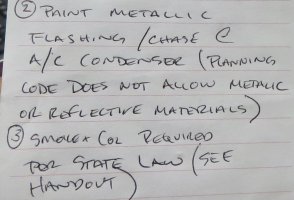
There is no code section for this and there is no Planning Dept requirement. This would be suppressed in Oregon.
IMG_4180.JPG

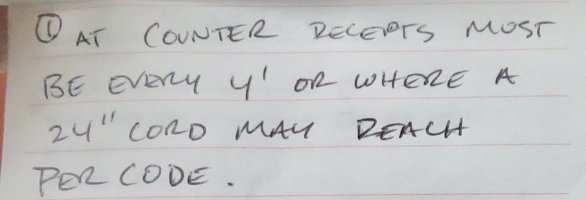
What was said here is tech. correct and factually flawed. A section # would lend authority and since they don't bother to look, it will not matter. It could be an improvement if nothing were written other than the code section number.
IMG_4182.JPG

This was an inspection for a water heater located in a garage. It was on a day devoted to 1hr. fire rating.
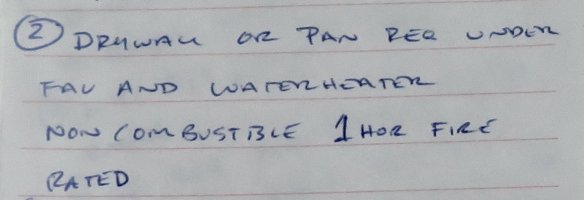

IMG_4386.JPG

There was almost a code section...almost because the muscle didn't have the dimensions memorized.

IMG_5875.JPG

With these pictures I have demonstrated the potential efficacy behind giving every Tom, Dick and Harry a section#. Up to a point. Beyond that I hope to also drive home the fact that the Tiger has left the building.
 
Last edited:
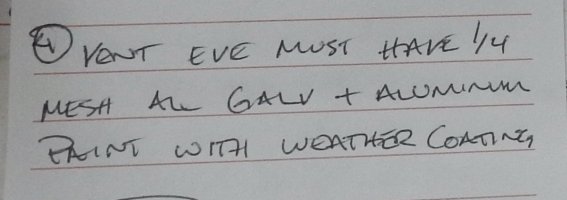
Could there be more? Can they be stranger still? All righty then, How about making them paint the eave vents. With a 'Weather Coating'.
DSCN1625.JPG

Expecting a crowd.

IMG_6816.JPG

The permit was for ceiling lights and two exhaust fans in bathrooms. Apparently they just found out that there will be a third mortgage to pay for HVAC.

IMG_6816 2.JPG

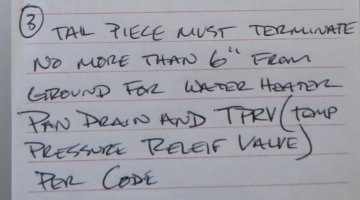
The confusion started with the 'tail piece'. This is one I've seen many times. There is a variation that states that the "tail piece" can't exit the building more than 6" above grade.


IMG_0141.JPG
 
Last edited:
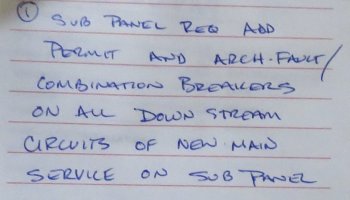
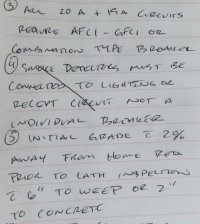
Make it an Easter egg hunt for a code on ARCH Fault breakers. Be sure to find all about the Combination type.

IMG_7585.JPG

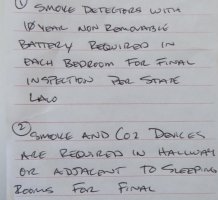
It is not a detector nor is it a CO2 device. There is not a requirement to replace smoke alarms that have not expired.

IMG_0141.JPG

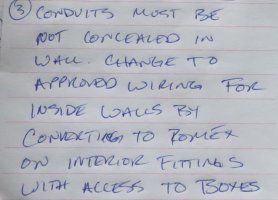
I wonder if they found a conduit that is listed for use inside a wall.

IMG_4168.JPG

Arbitrary and wrong. The grade prior to lath was a torture tactic. There was another correction to remove the sink in the laundry room. The sink would apparently encourage the occupants to create a second kitchen.

Extra kitchens are not just for the wealthy. LA County Planning Dept. allows just one kitchen. So often with Asian owners there would be plumbing left in an exterior wall for an outdoor kitchen. The plan was to get the final inspection out of the way and then bootleg the outdoor kitchen. My feeling was that since it is going to happen, why not do it the right way without busting open walls and making a Cobble Dick and Tibbs affair out of it. So I approved outdoor kitchens. Wish we had one of our own.

IMG_4213.JPG
 
Last edited:
When you see this do you wonder if they care about code section #s ???

IMG_0341.JPG

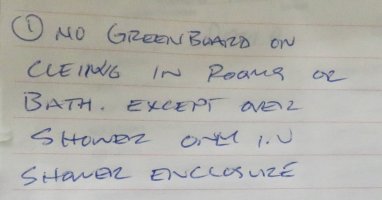
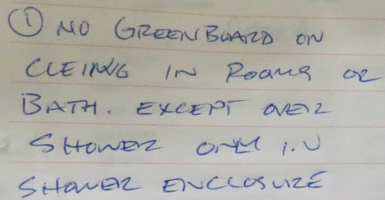
Green drywall is not allowed anywhere in a bathroom except a ceiling over a shower??? Perhaps a green clown scared the inspector as a child.

IMG_4171.JPG

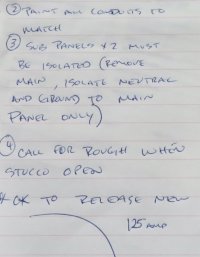
Painting conduit is never a valid correction. There is apparently two sub-panels with a neautral and ground tied together. However, the correction is just as confused as the electrician. Asking for the stucco to be 'opened' indicates that a thorough inspection did not take place. So there's two panels with a bonded neutral and there is more to be seen but the inspector is releasing this to Edison to be energized.
IMG_4012.JPG

Speaking of energized, I was there for a water heater inspection. Think of the code sections involved before I ever got to the drop.

IMG_2626.JPG
 
Last edited:
For plan check, it should be required. Full stop. I can't tell you how many times I get comments that tell me to do something that code doesn't require, or sometimes even touch on. It's also hard when the comment effectively says "this thing doesn't comply with code. Make it comply." Well, what are you basing it off of? With some codes, like the at times hieroglyphics that is California's code, there could be two sections of code that completely contradict the other but only apply in certain situations. Providing code sections makes sure everyone is on the exact same page. I know this post is more about inspections, but I wanted to mention that.

For inspections, I think it depends. The contractor should be following the drawings and the drawings have already been checked. It's not a perfect system, but it should get most code-related issues sorted. I've had more than a few inspectors demand something that isn't required, especially for accessibility. When I bring up the code section that contradicts what they say I need to do, they get all defensive and, half the time, just ignore me. To me, a code reference should only be required when there's a conflict in the plans. The rest of the time, you can just point to the plans and say "why didn't you do that". At least, that's my outside perspective on the matter...

I'd prefer if there was always a section reference because some contractors tend to ask me for help, but I get the efficiency argument too. SoCal is a different beast to where I live and work.
 
I used to be a big proponent of write-it, cite-it. I found that literally no one cares. I provide code citations immediately upon request, but only by request.

I long for worthy opponents. I'm glad this forum is here to keep me sharp.
 
Years ago, when wearing my architectural code consultant hat, I was retained by the owner of a small-ish old, inner city building that, like a great many buildings in that city and in the neighborhood, had a convenience store on the street floor and three stories of apartments above. A fire inspector had given him a list of 55 [alleged] issues that had to be corrected of the fire department was going to condemn the building.

At the time, my state used only an amended version of NFPA 101 as the fire safety code -- no NFPA 1, no IFC. So, at the time, I was fairly conversant with NFPA 101, and I couldn't figure out any justification for most the [alleged] citations. So I called the fire inspector. At first, he was extremely antagonistic and tried to stonewall. I finally talked him into meeting me for lunch to go over his report. By the end of lunch, 55 citations had been culled down to roughly 15 citations, with sections, which was then something that we could (and did) address. Basically, the fire inspector was on a power trip, and he just didn't like the owner so IMHO his end game was that he wanted to put the guy out of business.

I had a building official in another city do the same thing to the owner of a small motel that had experienced a fire in ONE sleeping unit. The fire had been completely contained to the one sleeping unit ... but the building official came up with a laundry list of things to be corrected throughout the entire motel. Again -- not a code section in sight. We took that one to a board of appeals, and the building official lost on virtually everything beyond the unit that was actually involved in the fire.
 
Last edited:
As a plans examiner I cite the code, every time. I used to believe it would cut down arguments, but it doesn't, because the folks that don't bother with the code, don't bother to read it even if I tell them where it comes from. Most of the time it just devolves into what they want to believe the code says, instead of what the code actually says. I used to believe my comments would prompt the reader of them to educate themselves and not make the same mistake over and over but that isn't happening either, see above. Now I just believe they are for my own edification and education, for my own diligence in making sure I don't make comments that are out of context, don't apply or just plain wrong. Mostly, they just help me when I inevitably need to revisit them during the arguments.

I rarely remember a section (even if I did, so many change from cycle to cycle many would be wrong), so I have to look it up every time, which is frustrating when I ABSOLUTELY KNOW I have made the comment before, ABSOLUTELY KNOW it is wrong, but I have to spend my time looking it up over and over. Then there are those times when I am ABSOULTEUY SURE about it until I read it again, and find out I am ABSOLUTELY WRONG. Looking up code sections, reading, re-reading, and cross referencing allows me to eliminate a lot of knee jerk reaction comments that I would make if I didn't look them up.

As an inspector I did my best to cite the code, but time and frustration often got in the way. I found then that the citation was most helpful to the CBO when he got the calls. Inspectors are not afforded the time to look it all up every time. If I was busy, I would skip the section numbers if I was sure about the deficiency.
 
I rarely remember a section (even if I did, so many change from cycle to cycle many would be wrong), so I have to look it up every time, which is frustrating when I ABSOLUTELY KNOW I have made the comment before, ABSOLUTELY KNOW it is wrong, but I have to spend my time looking it up over and over. Then there are those times when I am ABSOULTEUY SURE about it until I read it again, and find out I am ABSOLUTELY WRONG. Looking up code sections, reading, re-reading, and cross referencing allows me to eliminate a lot of knee jerk reaction comments that I would make if I didn't look them up.
This is my main complaint about some inspectors. They get old code and new code mixed up too often and don't bother looking at current code to see if what they're claiming is required.

I've been told multiple times by at least two inspectors this year to add a "12 inch groove boarder" at the top of curb ramps. That hasn't been a requirement for non-public housing since at least 2015.
 
some contractors tend to ask me for help
Contractors ask me about corrections that another inspector wrote. The first thing that I tell them is to ask for a section number. That's not the help that they are looking for. They simply want to know if the correction is valid.
The contractors do not want to challenge the inspector because they do not want to risk pissing off the inspector. The concern is that the inspector will torture them going forward. I point out that looking back I clearly see that the inspector has tortured them in the past.

I have told this story previously but it is worth repeating:

In my first week as an inspector I came across a furnace with an A/C coil. There's nothing odd about that. The coil had two plumbed condensate drains and no emergency drain pan. That was odd, as I I had never seen two condensate drains ... so I wrote a correction to install a smitty pan. That was early on the fourth day of my time as an inspector. That afternoon I did some research and discovered that I was wrong and no pan was required. Like I said, I was new to it.

I immediately called the contractor and that by itself was a surprise to the contractor. I said that I wanted to discuss the smitty pan. Right away he told me not to worry because it was already installed.
I told him that I was calling to tell him that I was wrong. .... He said, "Yes, I know" I replied, "Well then, why would you install the pan if you knew that I am wrong?" He said, "I do a lot of work in your area ... the last thing I want to do is piss off an inspector."
I told him that if he doesn't correct me when I am wrong....well that's gonna piss me off. He said that no inspector has ever admitted a mistake, much less try to make it right.

That day I knew that inspectors have way too much power. I have encountered a great many inspectors that have way to much power.

The contractor opened my eyes to a valuable lesson. I realized that if I was going to do the job I would have to police myself. I checked my citations to the code constantly. But I did that on my own time. There just wasn't time for that during the day.
I did progress to not needing to double check all but the arcane. You would be surprised about the number of things that you discover while rereading the code.

If you knew the time that I have spent immersed in code you would see just how strange I am. I am retired now and I can get tired just thinking about the thinking I did during those years.

So how does this relate to writing code section numbers. Could be it doesn't. But if you think about it, I would not have written the bogus smitty pan correction. I would have missed a career altering bit of knowledge. Who could deny me that?
 
I used to believe my comments would prompt the reader of them to educate themselves and not make the same mistake over and over but that isn't happening
I have asked contractors why they make the same mistake just weeks apart and I have been told that they were not aware that I was the inspector. It happens with solar contractors and electricians.
 
I have asked contractors why they make the same mistake just weeks apart and I have been told that they were not aware that I was the inspector. It happens with solar contractors and electricians.

Heh, heh --

A couple of years ago our electrical inspector had a solar contractor accidentally admit that their company maintains a list of what the inspectors in each town check -- so they may do the same installation differently in various towns based on what they think they'll be able to get away with.

There's a special place in hell for any contractor who plays that game.
 
Solar City had a file on me in 2004. The solar industry got over their skis to the point that they went to the top of LA County Public Works with the news that they would stop selling in my area. I for one would have been thrilled. My punishment was a two year stint on the UL 2703 Standard making panel. Solar City's file on me grew thicker. It was a slog with Solar City until they acquired ZEP Solar. Integrated bonding was another leap forward.

There are hundreds of small outfits from roofing contractors to HVAC and B-contractors that install solar and they are not so sophisticated as Tesla that they would have a file.... no they take their chances that the inspector won't get out of the car.
 

1764627312746.png

R702.3.7 Water-Resistant Gypsum Backing Board

Gypsum board used as the base or backer for adhesive application of ceramic tile or other required nonabsorbent finish material shall conform to ASTM C1178, C1278 or C1396. Use of water-resistant gypsum backing board shall be permitted on ceilings. Water-resistant gypsum board shall not be installed over a Class I or II vapor retarder in a shower or tub compartment. Cut or exposed edges, including those at wall intersections, shall be sealed as recommended by the manufacturer.

R702.3.7.1 Limitations

Water-resistant gypsum backing board shall not be used where there will be direct exposure to water, or in areas subject to continuous high humidity.
 

View attachment 17256

R702.3.7 Water-Resistant Gypsum Backing Board

Gypsum board used as the base or backer for adhesive application of ceramic tile or other required nonabsorbent finish material shall conform to ASTM C1178, C1278 or C1396. Use of water-resistant gypsum backing board shall be permitted on ceilings. Water-resistant gypsum board shall not be installed over a Class I or II vapor retarder in a shower or tub compartment. Cut or exposed edges, including those at wall intersections, shall be sealed as recommended by the manufacturer.

R702.3.7.1 Limitations

Water-resistant gypsum backing board shall not be used where there will be direct exposure to water, or in areas subject to continuous high humidity.
For many years there was a code that required 12" on center framing for WRG on a ceiling. Not now.
 
Last edited:

View attachment 17256

R702.3.7 Water-Resistant Gypsum Backing Board

Gypsum board used as the base or backer for adhesive application of ceramic tile or other required nonabsorbent finish material shall conform to ASTM C1178, C1278 or C1396. Use of water-resistant gypsum backing board shall be permitted on ceilings. Water-resistant gypsum board shall not be installed over a Class I or II vapor retarder in a shower or tub compartment. Cut or exposed edges, including those at wall intersections, shall be sealed as recommended by the manufacturer.

R702.3.7.1 Limitations

Water-resistant gypsum backing board shall not be used where there will be direct exposure to water, or in areas subject to continuous high humidity.
So it can be used in the bathroom just not the “ wet locations “….got it
 
There is a difference between a wet location and direct exposure.
There is still the prohibition"...in areas subject to continuous high humidity..." though that may be a bit subjective. Some family's bathrooms may be in near constant use. On the other hand, these days the requirements for humidity sensing bath fans and whole-house ventilation may mitigate the issue.

The previous green board ceiling "prohibition" wasn't a code prohibition AFAIK. I think it was that green board was heavier and had a tendency to sag more, so the manufacturers required 12" o/c framing support, which nobody wanted to do.
 
The contractors do not want to challenge the inspector because they do not want to risk pissing off the inspector. The concern is that the inspector will torture them going forward. I point out that looking back I clearly see that the inspector has tortured them in the past.
Dealing with stupid people is a form of torture....I can't wait until they outlaw it...Like waterboarding or the Hallmark Channel...
 
I encounter the statement by contractors on not wanting to call building inspectors on allegedly incorrectly sited code violations a fair amount.

I think there is some truth to the "pissing off the inspector", but I also believe it is mostly used as an excuse. Let's be honest. Most of the time, it is easier to just do whatever the inspector asks, than to evaluate what the code is actually asking for in a given circumstance, even if you have a "good" inspector that want's to stick to enforcing the code requirements.

There are three things I hear from the construction community all the time that I think are mostly just repeated mindlessly:
1. Just do whatever the inspector asks so you don't piss them off
2. There is too much difference in interpretation between one inspector to the next (they must be using different codes!)
3. Codes add too much to the cost of construction

When I've asked for specific examples, a contractor might have one, but far from the universal statement they are making.
#1 is an excuse to do whatever the inspector says.
#2 is an excuse not to know the codes
#3 is an excuse to blame increased cost of construction on something other than the market (code doesn't ask for granite countertops and engineered hardwood, but man, customers sure do).
 
I encounter the statement by contractors on not wanting to call building inspectors on allegedly incorrectly sited code violations a fair amount.

I think there is some truth to the "pissing off the inspector", but I also believe it is mostly used as an excuse. Let's be honest. Most of the time, it is easier to just do whatever the inspector asks, than to evaluate what the code is actually asking for in a given circumstance, even if you have a "good" inspector that want's to stick to enforcing the code requirements.

It's too bad that attitude hasn't expanded to include architects, engineers, and unlicensed building designers. They're never shy about challenging me when I say there's something wrong (or, probably more often, missing) in their construction documents. Many of them get downright nasty about it, and they don't hesitate to complain to town hall about it if their initial round of insults doesn't erase the citation. In more than one case, I've seen building designers waste more time arguing that they're right (even when I've cited the exact code section that says they're wrong) than it would have taken them to just make the correction(s). They never seem to mind that their refusal to admit they messed up is delaying their client's permit. They tell the client that the building department is being obstructionist.
 
Back
Top