• Welcome to The Building Code Forum

    Your premier resource for building code knowledge.

    This forum remains free to the public thanks to the generous support of our Sawhorse Members and Corporate Sponsors. Their contributions help keep this community thriving and accessible.

    Want enhanced access to expert discussions and exclusive features? Learn more about the benefits here.

    Ready to upgrade? Log in and upgrade now.

Travel distance at buildings with 2 levels of exit discharge

YonLL

REGISTERED
Joined
Aug 7, 2025
Messages
23
Location
New York City
Hi, I am working on this high-rise apartment building in NYC, where it has 2 street fronts, and there is one level height difference between the 2 streets (about 10'). This is a big site and has an enormous amount of units on each level. In evaluating the floor plan, the egress strategy on the 1st floor is kind of counterintuitive from a resident's perspective. This apartment building has apartment units at every level.

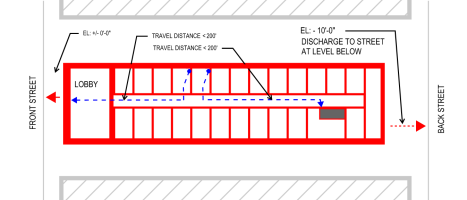
Below is a dumbed-down(NTS due to confidentiality) version of the 1st floor plan with the question highlighted. By instinct, you would think the apartments will split into 2 halves, with the first half egressing through the protected corridor, through the lobby, and directly out to the front street, and the other half going down to the stairs and discharging at the back street. However, as the diagram indicates, some units that appear closer to the front street need to travel through the stairs to satisfy the egress requirements. I think this is technically allowed, but from a tenant's perspective, I would never use the stairs unless the front egress is blocked(by fire, for example)

200' max is what is allowed in NYC for an R-2 fully sprinklered building.

I want to propose some side exits, but just want to get your opinions on this current condition that I described.

Thank you and have a good Thanksgiving holiday!

1764363751741.png
 
Hi, I am working on this high-rise apartment building in NYC, where it has 2 street fronts, and there is one level height difference between the 2 streets (about 10'). This is a big site and has an enormous amount of units on each level. In evaluating the floor plan, the egress strategy on the 1st floor is kind of counterintuitive from a resident's perspective. This apartment building has apartment units at every level.

Below is a dumbed-down(NTS due to confidentiality) version of the 1st floor plan with the question highlighted. By instinct, you would think the apartments will split into 2 halves, with the first half egressing through the protected corridor, through the lobby, and directly out to the front street, and the other half going down to the stairs and discharging at the back street. However, as the diagram indicates, some units that appear closer to the front street need to travel through the stairs to satisfy the egress requirements. I think this is technically allowed, but from a tenant's perspective, I would never use the stairs unless the front egress is blocked(by fire, for example)

200' max is what is allowed in NYC for an R-2 fully sprinklered building.

I want to propose some side exits, but just want to get your opinions on this current condition that I described.

Thank you and have a good Thanksgiving holiday!


View attachment 17231
I think that if at least one exit is within the 200 ft distance is enough for compliance.
 
only (1) of the required exits needs to be with in the maximum allowed travel distance from any point on the floor.
Agreed, but in this case I have to draw my path to the stairs. I don't think it is incorrect but it does feel that way since the natural path for that unit would be through the lobby.
 
There's nothing to stop somebody in one of the rear apartments from exiting through the front lobby, unless the corridor is filling up with smoke in which case anybody with sense will use the rear stairs.
 
I agree. It's just that in the life safety analysis, I have to draw the travel path to the stairs at the back, which feels wrong...

Why do you think it feel wrong? The door from the corridor into the stair enclosure is an "exit." That's where that path of exit access travel ends on the level you showed the plan for.

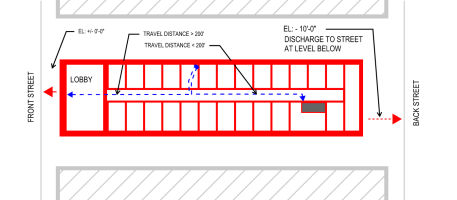
For what it's worth, that egress diagram is incorrect. You don't have to show TWO means (paths) of egress from one point. You only have to show that each remote point is within the allowable exit access travel distance from AN exit -- ONE exit. The correct way to represent that in your plan would be like this:

1764616077668.png
 
Last edited:
Why do you think it feel wrong? The door from the corridor into the stair enclosure is an "exit." That's where that path of exit access travel ends on the level you showed the plan for.

For what it's worth, that egress diagram is incorrect. You don't have to show TWO means (paths) of egress from one point. You only have to show that each remote point is within the allowable exit access travel distance from AN exit -- ONE exit. The correct way to represent that in your plan would be like this:

View attachment 17253
The diagram is just to illustrate the condition, not what I would actually put on life safety drawings. I understand only 1 path is required to meet the travel distance requirement. Why do I feel weird? Because it is telling people at least the "best way" to egress is through the stairs and down 1 level and out to a secondary street, when the front lobby is probably more intuitive for residents, even though it is further to the exit door. As I said, I think this is technically fine but it kind of hit me with this weird feeling and want to take on other people's opinion.
 
Unless one of two possible means of egress is blocked by the fire, the "best" path of exit access travel is generally deemed to be the shortest path of exit access travel. In a hotel, each individual room gets its own exit diagram, which shows THAT room relative to exits. The fact that people may intuitively head for an exit that's farther away because that's how they came in has nothing to do with the code. The reality is that in hotels, I suspect that at least 90% of occupants never look at that exit diagram posted on the inside of the corridor door.
 
Unless one of two possible means of egress is blocked by the fire, the "best" path of exit access travel is generally deemed to be the shortest path of exit access travel. In a hotel, each individual room gets its own exit diagram, which shows THAT room relative to exits. The fact that people may intuitively head for an exit that's farther away because that's how they came in has nothing to do with the code. The reality is that in hotels, I suspect that at least 90% of occupants never look at that exit diagram posted on the inside of the corridor door.
Fair enough.
 
The egress diagram on the construction documents that shows code compliance is different from the evacuation diagram required in hotel rooms by the IFC. The IFC evacuation diagram is unique to each room and must show two paths of egress travel.

1764622414171.png
This requirement applies to hotels and motels. Your question was about an apartment building. Apartments are not considered to be transient, so evacuation diagrams are not required in each apartment.
 
Back
Top