• Welcome to The Building Code Forum

    Your premier resource for building code knowledge.

    This forum remains free to the public thanks to the generous support of our Sawhorse Members and Corporate Sponsors. Their contributions help keep this community thriving and accessible.

    Want enhanced access to expert discussions and exclusive features? Learn more about the benefits here.

    Ready to upgrade? Log in and upgrade now.

2024 IRC Existing Stairways

BN4537

SAWHORSE
Joined
Sep 10, 2020
Messages
1,038
Location
Kansas
Section 318.7.9 of the 2024 IRC states, in it's entirety, that “Alterations to existing stairs shall not be required to comply with the requirements of this code where the existing space and construction does not allow a reduction in pitch or slope.”

And that is it. Nowhere does it specify, or adjacent sections specify, that the requirements of the code you are not required to comply with are limited to slope and head height.

As written, do you agree that this would mean that you could not enforce handrails, guardrails, risers with more than 3/8" variance, egress width, fire protection on the bottom of the stairs, etc.? That wasn't the intent, surely.

I am asking because we are going through code adoption and we could amend this section a little to meet intent without compromising other requirements.
 
As written, do you agree that this would mean that you could not enforce handrails, guardrails, risers with more than 3/8" variance, egress width, fire protection on the bottom of the stairs, etc.? That wasn't the intent, surely.

I am asking because we are going through code adoption and we could amend this section a little to meet intent without compromising other requirements.

No, I don't agree. The intent is to not require a replacement stair to be a 7:11 stair where the original was an 8:9 stair. Keeping the new [replacement] stair within the existing footprint doesn't prevent providing compliant handrails, guards, protected soffit, and limiting variations in riser height to 3/8".

If that's not clear, then your jurisdiction probably should amend it in adoption.
 
It must just be me. "Intent" is not code, but at some point, a building official just needs to grow a spine and make the right things happen.
 
I agree, the wording is overly broad — it should clearly limit the exemption to pitch or slope; otherwise, it unintentionally waives other safety elements like handrails and guards.
 
the wording is overly broad
The wording is actually specific to stairs. Stairs are one component of a stairway. Stairs are made up of treads and risers. Anything not treads and risers is not "stairs".

R318.7 Stairways
Now there is a bunch of items that make a stairway with rules for each. From width to headroom and even tread nosings. There's handrails, guards and even lights. Along with all of it, there's stairs as it is after all the way for stairs.
The IRC defines stair as:
STAIR. A change in elevation, consisting of one or more risers.

Then you get to 318.7.9:
Alterations to existing stairs shall not be required to comply with the requirements of this code where the existing space and construction does not allow a reduction in pitch or slope.

Note that there is two considerations. Space and construction.
Perhaps there is insufficient space. Is that the end of rumination or does construction have to also prevent an attempt at strict code compliance.

Assume there is not enough room but eliminating part of a bedroom closet would make it happen. Can the claim be made that the existing construction was such that it required removing and constructing walls. Therefor both "space and Construction" have not been met. The existing construction would "allow" the elimination of closet space.

What if there is insufficient space and the only way to fix that would be extending the building footprint. The existing construction would not "allow" without the creation of new construction. Clearly that would be a failure of the existing construction.
Of course there are certainly other physical constraints of the existing construction that could stand in the way. That's where the subjective estimation of a building official becomes paramount.

Gosh! I hope that clears things up for you.

Code never covers it all,
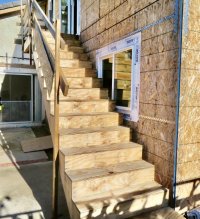
49284465382_e8a2aed778_b 2.jpg
 
Last edited:
The exception should also include width. There are a lot of 30" - 32" wide stairs in houses built before the 1970s. Increasing the width to 36" would be at least as disruptive structurally as extending the run.

If I remember correctly the 36" width was adopted because people were buying larger furniture and movers had a lot of trouble getting it up and down narrower stairs.
 
Back
Top