
The question has come up many times scattered in threads that were drifted into a ditch. It just happened again so I brought my reply here.
1. For example, office managers are seldom versed in code so when a constituent questions a violation, there is a roadmap for the manager. Of course that leaves that manager in the weeds with no understanding of the code that he had at his fingertips, but that's another issue.
2. A plus to providing code sections is the likelihood that the imbecile inspectors would be curtailed with their bogus corrections. But then, stupid goes all the way to the bone so perhaps that wouldn't work as well as I imagine.
3. The Yankee has mentioned respect for court proceedings. I have written north of 200K corrections and been in court twice. On both occasions it was two people suing each other. The one time where I came close to a court case, I fabricated the entire code without a section# in sight. I've probably already told that story, it was a doozy. (p.s. I did tell that story on 2/11/2025)
Having exhausted the obvious advantages. There are disadvantages.
1. The time taken looking up each correction can be significant. I suppose that over the long haul, there would be muscle memory. (the brain is a muscle) Cheat sheets are available. I have a stack of the Code Check aids. However, the time is wasted.
2. The one in 400 hundred contractors that demand a code section will have deflated sails. So I'm going on the offensive to thwart that single malcontent that comes around on the third Thursday of every month.
3. Here in SoCal the level of expertise with building inspectors is low. Like in in a basement toilet low. They do not write many corrections because they don't recognize violations. If they were required to include sections...well the inspection was for naught.
I can say with certainty that the condition holds true with contractors as well as inspectors. So we have the blind leading the blind and between the two of them they can't understand a code section. Be honest and see the truth found here in this forum. A question about the dimensions of a stair landing produced fifty replies. An exit sign might be required ...or maybe not... could be a good idea ...or wait a minute, does it create a hazard? Ah! But a code section clears the smoke???
Some would say that sounds harsh. Well they are the exception rather than the rule. It all depends on where and with whom you practice your craft. I had jobs with Oltmans Construction that generated discussions to the point that they gave me a NEC Code Manual so we could keep it going. I've had far more experience where I was the only English speaker for a two block radius.
4. There's probably a 4,5,&6 but I have tired with this for now. I can come back later if I think of 4,5&6.
The following citations were written by a Senior Inspector. The individual has in excess of twenty ICC certifications. Picture a code section with each violation. Know that several are whole cloth out of thin air.
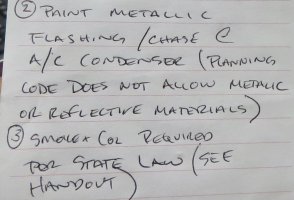
There is no code section for this and there is no Planning Dept requirement. This would be suppressed in Oregon.
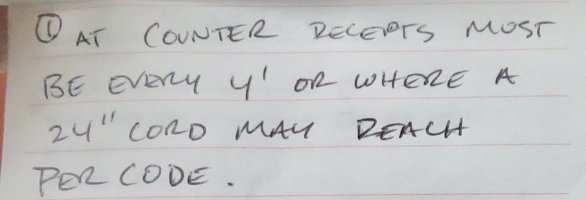
What was said here is tech. correct and factually flawed. A section # would lend authority and since they don't bother to look, it will not matter. It could be an improvement if nothing were written other than the code section number.
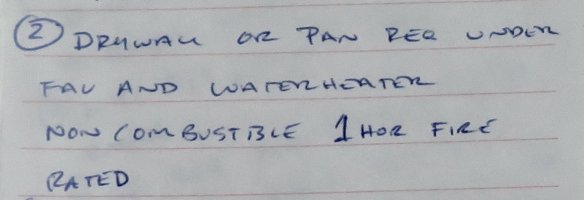
This was an inspection for a water heater located in a garage. It was on a day devoted to 1hr. fire rating.
There was almost a code section...almost because the muscle didn't have the dimensions memorized.

With these pictures I have demonstrated the potential efficacy behind giving every Tom, Dick and Harry a section#. Up to a point. Beyond that I hope to also drive home the fact that the Tiger has left the building.
There are practical benefits to including a code section.Since 2006, OREGON requires all jurisdictions to cite the code sections for each violation. "Cite-it Write-it" And yes, we provide the code section(s). To the credit of the State, every inspector, plans examiner and Building Official has to be certified by the State of Oregon. (It can be such a pain looking up the codes sections!)
1. For example, office managers are seldom versed in code so when a constituent questions a violation, there is a roadmap for the manager. Of course that leaves that manager in the weeds with no understanding of the code that he had at his fingertips, but that's another issue.
2. A plus to providing code sections is the likelihood that the imbecile inspectors would be curtailed with their bogus corrections. But then, stupid goes all the way to the bone so perhaps that wouldn't work as well as I imagine.
3. The Yankee has mentioned respect for court proceedings. I have written north of 200K corrections and been in court twice. On both occasions it was two people suing each other. The one time where I came close to a court case, I fabricated the entire code without a section# in sight. I've probably already told that story, it was a doozy. (p.s. I did tell that story on 2/11/2025)
Having exhausted the obvious advantages. There are disadvantages.
1. The time taken looking up each correction can be significant. I suppose that over the long haul, there would be muscle memory. (the brain is a muscle) Cheat sheets are available. I have a stack of the Code Check aids. However, the time is wasted.
2. The one in 400 hundred contractors that demand a code section will have deflated sails. So I'm going on the offensive to thwart that single malcontent that comes around on the third Thursday of every month.
3. Here in SoCal the level of expertise with building inspectors is low. Like in in a basement toilet low. They do not write many corrections because they don't recognize violations. If they were required to include sections...well the inspection was for naught.
I can say with certainty that the condition holds true with contractors as well as inspectors. So we have the blind leading the blind and between the two of them they can't understand a code section. Be honest and see the truth found here in this forum. A question about the dimensions of a stair landing produced fifty replies. An exit sign might be required ...or maybe not... could be a good idea ...or wait a minute, does it create a hazard? Ah! But a code section clears the smoke???
Some would say that sounds harsh. Well they are the exception rather than the rule. It all depends on where and with whom you practice your craft. I had jobs with Oltmans Construction that generated discussions to the point that they gave me a NEC Code Manual so we could keep it going. I've had far more experience where I was the only English speaker for a two block radius.
4. There's probably a 4,5,&6 but I have tired with this for now. I can come back later if I think of 4,5&6.
The following citations were written by a Senior Inspector. The individual has in excess of twenty ICC certifications. Picture a code section with each violation. Know that several are whole cloth out of thin air.
There is no code section for this and there is no Planning Dept requirement. This would be suppressed in Oregon.
What was said here is tech. correct and factually flawed. A section # would lend authority and since they don't bother to look, it will not matter. It could be an improvement if nothing were written other than the code section number.
This was an inspection for a water heater located in a garage. It was on a day devoted to 1hr. fire rating.
There was almost a code section...almost because the muscle didn't have the dimensions memorized.
With these pictures I have demonstrated the potential efficacy behind giving every Tom, Dick and Harry a section#. Up to a point. Beyond that I hope to also drive home the fact that the Tiger has left the building.
Last edited:
