• Welcome to The Building Code Forum

    Your premier resource for building code knowledge.

    This forum remains free to the public thanks to the generous support of our Sawhorse Members and Corporate Sponsors. Their contributions help keep this community thriving and accessible.

    Want enhanced access to expert discussions and exclusive features? Learn more about the benefits here.

    Ready to upgrade? Log in and upgrade now.

Taller single egress buildings?

So if I am reading this right Nashville can up to 6floor with a single exit. The travel distance is now defined as going from the furthest point all the way to the exit discharge. How on earth are you going to have a travel distance of 125ft with 6 stories. With the stairs being 25ft of travel per floor that already exceeds the 125ft limit, let alone the furthest distance on that floor. Are they allowing the door into a two-hour rated stair tower as an exit discharge from that floor.
I don't believe they have changed that...Some of them say 25' from the unit door to the exit enclosure...
 
I don't think I fully understand this:

6.20 Emergency escape & rescue openings served from a yard or court shall be afforded a 5’x 5’ unobstructed area at ground level.
Splat area from the 5th story?

And still no emergency lighting freaks me out especially after the Grenfell phone call audio...
 
I don't think I fully understand this:


Splat area from the 5th story?

And still no emergency lighting freaks me out especially after the Grenfell phone call audio...
I’m guessing it relates to setting up a ground ladder for rescue, to afford occupants on lower floors more options?

See this thread from a couple of years ago on the forum.
 
Last edited:
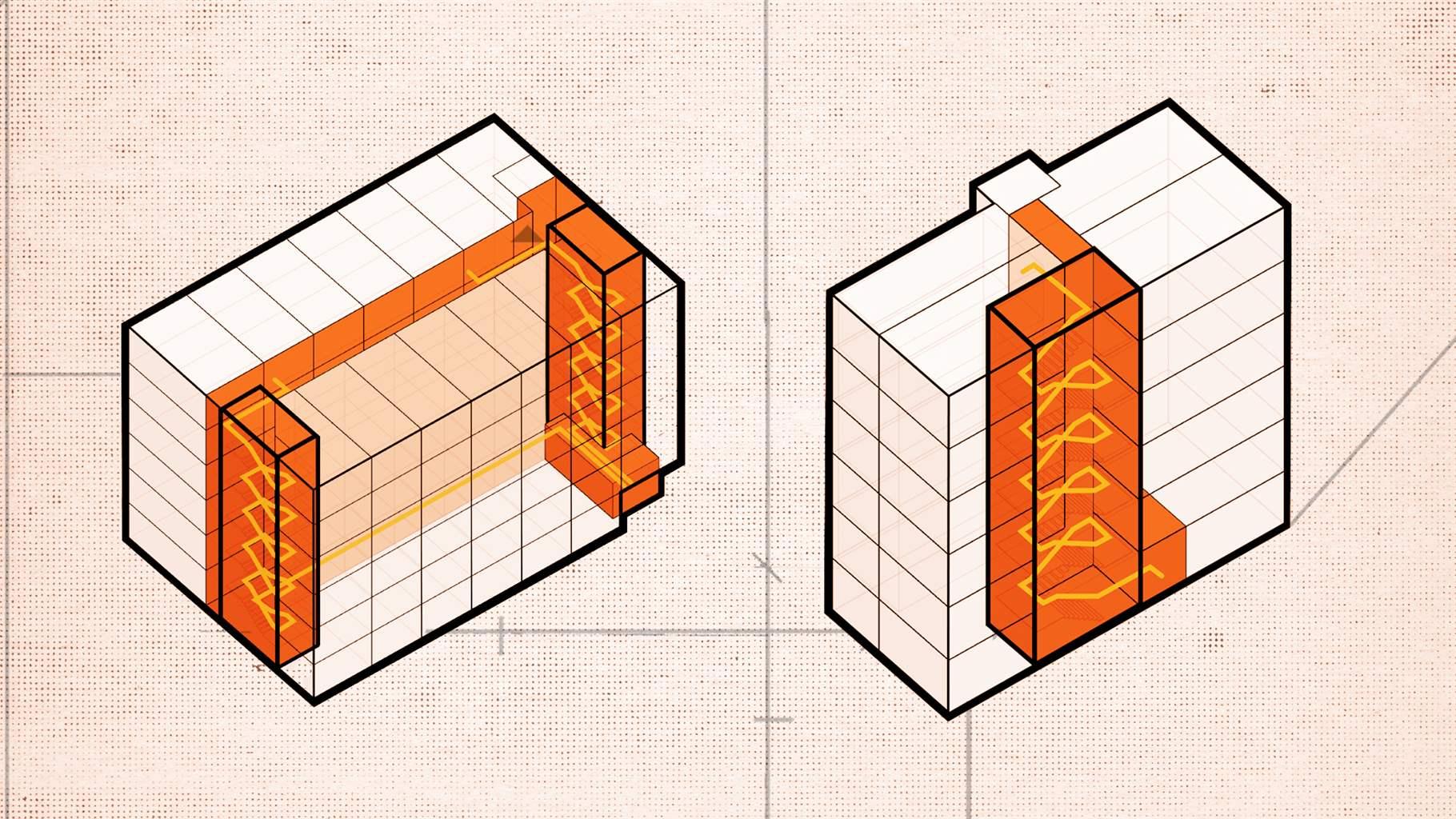
What I like about this document is that it helps explain that the single is about more than just saving ~15% of floor plate area; it's about being able to configure multifamily housing onto narrower lots, thus increasing the number of lots that can be developed. The apartment on the left requires a lot at least 75'-80' wide, whereas the the one on the right could fit on a 50' wide lot.

1763512493083.png
 
Yes. Required MOE and Accessible MOE are 2 different things, though some components can fulfill both, depending on other design conditions and features.

View attachment 17047
Can I ask why the stairs are not listed as a AMOE for a building in excess of 4 stories? Any stair 48" in width between the handrails and provided with an area of refuge can be considered as such? Unless this is a 2024 thing?
 
Can I ask why the stairs are not listed as a AMOE for a building in excess of 4 stories? Any stair 48" in width between the handrails and provided with an area of refuge can be considered as such? Unless this is a 2024 thing?
I don’t know any specifics of that portion of the code development. I can speak from personal anecdotal experience. My firm used to be located on the top floor of a 7 story historic office building, first built in 1928. It had two elevators, one stairwell (open), and one fire escape. The building had an emergency generator, but I don’t know if it powered the elevators.

One day the manual fire alarms went off. (There was a computer that had started smoking on the 5th floor. That was easily brought under control by simply unplugging it.). Everyone evacuated via the stairs. On the 6th floor there was a paraplegic employee in a wheelchair. Everyone thought of him, and many of us went to help. The signs at the elevator said “in case of fire, do not use elevator”. So four people (not firefighters) each took a corner of the wheelchair and carried him downstairs in the chair. About every 2 stories, they stopped to switch out with others to help carry. The stair was about 6’ wide, and there was room to pass, both on the stair flights and at landings. It took them a while, but they made it down OK.

My impression was that the process took too long to get the chair user - and the people concerned for him - out of the building as compared to having some other system available. If the building did not have so many able-bodied co-workers to assist, it would have taken 2 or more emergency personnel to help him, instead of them doing other firefighting activities.

So maybe the prescriptive 4 story limit for AMOE stairs has to do with the amount of time and energy that emergency personnel would need to devote to carrying someone downstairs, vs. firefighter operation of the elevator.
 
Can I ask why the stairs are not listed as a AMOE for a building in excess of 4 stories? Any stair 48" in width between the handrails and provided with an area of refuge can be considered as such? Unless this is a 2024 thing?
Assuming a privately funded project, they are not required to include an elevator in the design. If they don't provide an elevator, then only the ground floor is required to be made accessible.

1009.1 Accessible means of egress required. Accessible
means of egress shall comply with this section. Accessible
spaces
shall be provided with not less than one accessible
means of egress. Where more than one means of egress is
required by Section I 006.2 or l 006.3 from any accessible
space
, each accessible portion of the space shall be served by
accessible means of egress in at least the same number as
required by Sections 1006.2 or 1006.3.....

AMOE is only required from accessible spaces. In the case of a privately funded single stair building with no elevator, only the ground floor would require AMOE.

 
Assuming a privately funded project, they are not required to include an elevator in the design. If they don't provide an elevator, then only the ground floor is required to be made accessible.

1009.1 Accessible means of egress required. Accessible
means of egress shall comply with this section. Accessible
spaces
shall be provided with not less than one accessible
means of egress. Where more than one means of egress is
required by Section I 006.2 or l 006.3 from any accessible
space
, each accessible portion of the space shall be served by
accessible means of egress in at least the same number as
required by Sections 1006.2 or 1006.3.....

AMOE is only required from accessible spaces. In the case of a privately funded single stair building with no elevator, only the ground floor would require AMOE.
They generally will put in the elevator and then it will be the AMOE..
 
They generally will put in the elevator and then it will be the AMOE..
I thought it would be required, but I can't find anything anywhere in code that says an elevator would be required for a privately funded R-2 building.

But I agree 100%, they will almost always install one because their tenants will want one, and if it's there then it would make the most sense to design it as the AMOE.
 
I thought it would be required, but I can't find anything anywhere in code that says an elevator would be required for a privately funded R-2 building.

But I agree 100%, they will almost always install one because their tenants will want one, and if it's there then it would make the most sense to design it as the AMOE.
Any R-2 under 4 stories in our state does not require an elevator...FHA does not require it either that I am aware of
 
They generally will put in the elevator and then it will be the AMOE..
When we provide an elevator we still try to avoid making it the AMOE because 1009.4.1 would require it to have standby power, e.g. an emergency generator. For 5+ stories, we'll use a horizontal exit system instead - - but that won't work on a single stair building.
 
Back
Top