• Welcome to The Building Code Forum

    Your premier resource for building code knowledge.

    This forum remains free to the public thanks to the generous support of our Sawhorse Members and Corporate Sponsors. Their contributions help keep this community thriving and accessible.

    Want enhanced access to expert discussions and exclusive features? Learn more about the benefits here.

    Ready to upgrade? Log in and upgrade now.

Egress width

  • Thread starter Thread starter Mech
  • Start date Start date
  • Featured

Mech

REGISTERED
Joined
Oct 30, 2009
Messages
1,067
Location
Eastern PA
2018 IBC
S use group

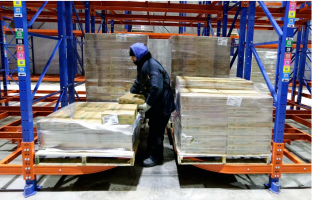
Is egress distance between pallets regulated by the IBC? An occupant can walk toward the back of the racking and come back out. They cannot get to the racking on the other side from this side.

1762279856882.png
 
Is egress distance between pallets regulated by the IBC?
Yes, it is part of the exit access.

If what you are showing is an employee’s area work area (like in the back of a building supply house) then I’d say the space between pallets is an employee work area, per IBC 2018 1104.3.1 common use circulation paths in employee work areas must be accessible routes, doesn’t look like what you’re showing in the picture qualifies for an exception. Then if it’s an accessible route what about a turning space?

An occupant can walk toward the back of the racking and come back out.
Not in what you show here, sliding in sideways is not walking.
 
The photo shows storage rack systems, with pallets laded and unloaded via forklift. There are multiple tiers. At the upper tiers, clearly no one can physically reach the pallets. The forklift would bring the pallet down to the floor surface, where the pallets and the items stored on them could be handled by workers.
In the photo, the lowest tier is not touching the floor. It too is elevated, just like the tiers above it. The space where the guy is standing is not intended to be a work area. It is intended to provide a route to maintain the racks (or to be more blunt, vermin and pest control between the racks).
The fact that someone can get into the space does not mean it is intended to be a work area, any more that providing an attic crawl space and hatch means that the attic is intended to be an employee work area.
 
Yikes - I failed to include this in the original post: this racking is intended for workers to lift and carry stored products.

I pulled the photo from Frazier.com, Ergo series pallet racking.

I suppose the official policy could be to use the forklift to move the pallet into the aisle, remove product as needed, and then return the pallet to the rack.
 
I suppose the official policy could be to use the forklift to move the pallet into the aisle, remove product as needed, and then return the pallet to the rack.
How about they hire people not in a wheelchair.
 
How about they hire people not in a wheelchair.
My understanding of ADAS 206.2.8 is that certain kinds of employee work areas do not need to be accessible, but "common use circulation paths" [the bigger aisle in the foreground of the photo] do need to be accessible.
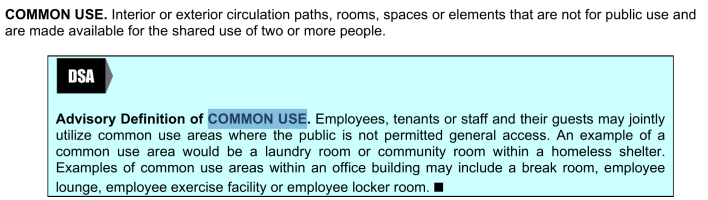
Here in California, our state code defined "common use" as being interior or exterior (1) circulation paths, (2)rooms, (3) spaces, or (4) elements that are NOT for public use and are made available for the SHARED USE of TWO OR MORE people.

In the photo in post#1, unless two employees are sharing that space between the pallets, it's not a common use circulation path.
 
are made available for the SHARED USE of TWO OR MORE people.

In the photo in post#1, unless two employees are sharing that space between the pallets, it's not a common use circulation path.
I always thought that “shared use” meant “available for use by more than one employee but not necessarily at the same time." So if after the person in the photo gets their materials and takes them up to a customer, if another employee can also go in the same space and get materials I thought that was “shared use.” But if the space where the person is standing was his private stash of materials it would be like a private office without walls and therefore not “common use.”
 
I always thought that “shared use” meant “available for use by more than one employee but not necessarily at the same time." So if after the person in the photo gets their materials and takes them up to a customer, if another employee can also go in the same space and get materials I thought that was “shared use.” But if the space where the person is standing was his private stash of materials it would be like a private office without walls and therefore not “common use.”
Here in California at least, it's heavily implied to be a space that is usable by two people at the same time.

1762369711241.png
 
Yikes - I failed to include this in the original post: this racking is intended for workers to lift and carry stored products.

I pulled the photo from Frazier.com, Ergo series pallet racking.

I suppose the official policy could be to use the forklift to move the pallet into the aisle, remove product as needed, and then return the pallet to the rack.
Or take off the front of the pallet and rotate....We don't need to regulate this....
 
Ya the product must be food or it would be parked on the concrete.
I have a friend with a PhD in food science and he heads up food safety for one of the largest grocery chains in America. He is responsible for almost 20% of the national retail food supply. It sounds dramatic, but his whole professional life comes down to vermin infestation control. It's like Homeland Security, but instead of battling terrorist cells they battle rats. You'd be amazed at the technology they deploy. There's special powders and coatings they can put on a floor and then use sensors to follow the mouse tracks back and forth from nests to preferred foods. The elevated pallets help them understand the floor routes and exterminate the threats quickly.
 
That definition is clearly aimed at defining when a room or space is a common use area. I don't think I would be comfortable extending it to apply to a dead-end space between pallets off an aisle in a warehouse.
I don't think I would consider that space in the photo (where the dude is standing) as being designed for two people to occupy at the same time. Could two people be there? Sure. But a single-user toilet room has enough space for two or more people to stand in it the same time, and that's not considered a common use space.
 
I don't think I would consider that space in the photo (where the dude is standing) as being designed for two people to occupy at the same time. Could two people be there? Sure. But a single-user toilet room has enough space for two or more people to stand in it the same time, and that's not considered a common use space.

Au contraire.

If a single occupant toilet room is available for use by any occupant of a building, or by any employee, I believe it IS a common use area. If that same single user toilet room is accessed through the president's office and is reserved for use by the president only, then it's not a common use area.
 
Shirley I am not the best one to call out thread drift but....This was supposed to be about egress not really accessibility. I've been under the racking grabbing stuff at HD or Costco a few times, but I would not call it "occupied"....

[BE]EXIT ACCESS. That portion of a means of egress system that leads from any occupied portion of a building or structure to an exit.

I would put the question to the designer and building owner as to how the racking system is supposed to function and likely just file whatever answer they gave me in the records for the miniscule chance of the future lawsuit...
 
Au contraire.

If a single occupant toilet room is available for use by any occupant of a building, or by any employee, I believe it IS a common use area. If that same single user toilet room is accessed through the president's office and is reserved for use by the president only, then it's not a common use area.
After rereading code, I think you're right...

DSA-AC (state accessibility, which adopts the definition of "common use") also adopts CBC 907.5.2.3.1, which states "Visible alarm notification appliances shall be provided in public use areas and common use areas, including but not limited to:... Shared office rooms used by two or more persons... Normally occupied room(s) used by two or more persons such as mother's room, phone room, quiet room, wellness room, etc... Normally occupied storage room/area...".

Nowhere does it say that two people need to occupy the space at the same time, and some of those rooms are clearly not going to be public use in most/all cases and won't be used by multiple people at the same time. So they're common use by default.

Thanks!
 
Back
Top